Monday, November 18, 2013
no image

Do educators suffer from the Lemming Condition?

Award-winning actor and author, Alan Arkin, tells a brilliant tale in his young adult novel, The Lemming Condition.

The story is an allegory on conformity, as Bubber, a lemming, is faced with following his entire race to self-induced extinction.

 Bubber struggles to decide if he should participate in what appears to be an insane death walk, only to constantly be told by family and friends that this is just the way things are. I won't ruin the ending, but let's just say that Bubber isn't your garden variety conformist.

Several conversations with colleagues have me wondering if Arkin's lemmings could have just as easily been today's teachers -- legions of people who conform daily to the principles of traditional methods and administrative pressure to teach to the test.

Like Bubber, we are constantly told this is just the way things are. Bubber was faced with extinction.

One must wonder, are educators next?

A version of this post originally appeared on The Results Only Learning Blog
Friday, November 8, 2013
Meaningful narrative feedback in action

Meaningful narrative feedback in action

Providing meaningful narrative feedback for students is one of the most powerful, yet overlooked, parts of 21st-century teaching and learning. 

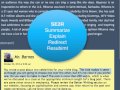
Efficient feedback includes Summary, Explanation, Redirection and Resubmission, or what I refer to as SE2R. This video demonstrates the SE2R formula, using a student's blog post.


To learn more about the SE2R formula, check out my book, Role Reversal. 


A version of this post originated at Learn it in 5. 
Thursday, November 7, 2013
Do you self-evaluate?

Do you self-evaluate?

In a Results Only Learning Environment, students are taught that reflection and self-evaluation are far more important than the judgment of a teacher. I want my students to be as hard as themselves and I am on myself.
I remind students constantly that I spend time daily reflecting on what took place in my classroom. "I evaluate myself, just as I evaluate you," I tell them. I often discover things that didn't go as I had planned.

Sometimes this means presenting them again another day in a different way. Other times it means discarding a lesson or activity completely. I firmly believe that this reflection and self-evaluation are the most important parts of making teachers better.

So, do you evaluate yourself? What does your reflection help you discover about teaching? Please share your thoughts.


This was originally posted at the Results Only Learning Blog
Tuesday, November 5, 2013
Hey teachers, stop asking parents to do your students'  homework!

Hey teachers, stop asking parents to do your students' homework!

I have never been so tired of the homework, and I am done with it. It's the piles of homework my kids bring home that I have to help them with do that I'm sick of. 


Today, it was perimeter in math, which I haven't done in about 38 years. Then, it was geography. "Which continent is west of New Zealand?" Seriously? First, where the hell is New Zealand, and why do I need to know what is west of it?

I'm considering contacting her school and asking to be added to the payroll. I'm fed up, and I'm not doing any more of this ridiculous, useless homework.


This is an updated form of a post that originally appeared at the Results Only Learning Blog
Wednesday, October 30, 2013
no image

NCTQ gets it wrong

The National Council on Teacher Quality recently published its Teacher Prep Review, an exhaustive study on teacher effectiveness, based on how we prepare educators to be classroom teachers. The 94-page study asks plenty of interesting questions about teacher preparedness.  

Photo credit: PBS.org
This lengthy study should give all educators a moment of pause. Indeed, the fact that such a study even exists speaks volumes about the current state of education. However, there is plenty to be concerned about, with regard to how this study is conducted. Note page 1 of the report:

"As the product of eight years of development and 10 pilot studies, the standards applied here are derived from strong research, the practices of high-performing nations and states, consensus views of experts, the demands of the Common Core State Standards (and other standards for college and career readiness) and occasionally just common sense."

See any problems here? The studies are based on so-called high-performing nations and states and the views of so-called experts and, you guessed it, Common Core State Standards. The credibility of research that measures educators against other nations and against the CCSS must immediately be called on the proverbial carpet. Here's more from the report:

"Fewer than one in nine elementary programs and just over one-third of high school programs are preparing candidates in content at the level necessary to teach the new Common Core State Standards. . ."
Hmm., what is meant, I wonder, by "at the level necessary to teach the new Common Core?" Just who has decided what this necessary level is? In fact, rarely are the people most knowledgeable in a subject area the best teachers. I've known engineers and attorneys, who attempted to be teachers but couldn't escape back to the private sector fast enough, once they encountered the real issues that the everyday classroom presents.

The NCTQ report is hard on colleges and universities that allow educators to "enter the classroom as teachers without institutions having ensured they possess adequate content knowledge," which the report states will not fix a broken system.

Is the education  system broken? Absolutely. Does the NCTQ have the solution figured out? Absolutely not! In fact, I'm frustrated that the NCTQ would spend eight years studying over 1,100 teacher prep programs, only to pin most of its findings on how well educators can teach the Common Core State Standards.

Teacher preparation needs to be changed. Comparing us to nations no larger than Montana and looking at the tactics of dilettantes like Teach for America is simply not the best approach to fixing teacher preparation. I have some ideas, but I'll save those for a future post.

Meanwhile, what do you think?


This was originally published at The Results Only Learning Blog

Tuesday, October 29, 2013
no image

Am I an awful teacher or a great one?

The new trend in public education is to measure teacher accountability, based on standardized test results. Using this year's results, the state of Ohio must deem me an awful teacher. 

Wait a minute, on the other hand, Ohio might think I'm a great teacher. Hmm., which am I? 

via: 17calculus.com
The list of problems with this ill-conceived system is far too long to place in one blog  post, so I'll discuss the one issue that would top the list that makes teacher accountability based on a test impossible.

I call this issue, "uncontrollable factors."

For example, one of my students who failed the reading test -- solely my fault, according to the state of Ohio -- had many personal problems that severely minimized her interest in language arts and other subjects. She missed 25 days of school. She was suspended from school four times. She received 14 grades of D or F on her report card throughout the year. Her parents never responded to any of my innumerable calls during the second half of the year.

While my average student read 28 books during the school year, she read two.What could possibly motivate this child to put in her best effort on a two and a half hour reading test?

Conversely, I have many students who scored close to perfect on the reading test. They are avid readers, scholar-athletes, student government leaders and have marvelous parents who encourage a love of  learning both in and out of school. According to the state of Ohio, I am solely responsible for their fine efforts on the achievement test.

I have little, if any, control over the out-of-class lives of either the poor students or the excellent ones. 

So, am I an awful teacher or am I a great one?


This was originally posted at the Results Only Learning Blog
Thursday, October 24, 2013
no image

Experts speak out against homework

This remarkable video will be presented by the organization Race to Nowhere to the National PTA.

Readers here know my feelings on homework, but this video does a remarkable job of summing up my opinions on the deleterious effects of homework on our children.
 

This was originally posted at The Results Only Learning Blog. It's certainly worth further consideration by all educators.
Thursday, October 10, 2013
Top 5 reasons I don't assign homework

Top 5 reasons I don't assign homework

This is the first of many popular posts I'll share here that I've written and posted elsewhere.

The homework debate is one that may plague educators for decades -- even centuries -- to come. It perplexes me, because the research is so overwhelmingly against homework's effectiveness.

After much consideration and exhaustive research, I stopped assigning homework a few years ago. Homework simply doesn't fit into a Results Only Learning Environment. Although I could write endlessly about the deleterious effects of homework, I'll get right to the top five reasons I don't assign homework.

5 -- Virtually all homework involves rote memory practice, which is always a waste of time. In the age of the Smartphone, who needs to remember by rote?

4 -- Homework has nothing to do with teaching responsibility (HW advocates love this claim). Not only is there not one reliable study to prove that homework builds responsible children, based on what we know about responsibility, the assertion is illogical. Responsibility implies autonomy, and homework offers none of this. Students are told what to do, when to do it, and when it must be returned. Where does responsibility come into play?

3 -- Homework impinges upon a student's time with family and on other, more valuable, activities -- like play. As Alfie Kohn states in The Homework Myth, why should children be asked to work a second shift? It's unconscionable to send children to work for nearly eight hours a day, then have them go home and work for 2-5 more hours; we don't live in 19th century London.

2 -- I can teach the material in the time I'm with my students in the classroom. The endless cry of "I can't teach all of the standards without assigning homework" is a tired excuse used to hide ineffective methods. Creating engaging activities in place of lecture and worksheets, along with less testing will eliminate the need for homework.

1 -- Students hate homework. I want to help  my students develop a thirst for learning. I want them to read for enjoyment and exploration. I want them to extend their learning when they choose, because they are interested in what we do in class. If I force them to do activities that they don't choose, they will hate them. If I penalize them for not completing something they see as valueless, they not only don't learn, they get a bad grade and hate learning even more. My colleagues often attempt to persuade me that homework is an integral part of teaching and learning. I'm simply  not buying.

So, what's your take on the debate?
Copyright © 2014 Brilliant or Insane? All Right Reserved
Designed by CBTblogger